

Proverbs have carried practical wisdom from one generation to the next for hundreds of years, long before modern advice columns or self help books existed. A single short sentence, such as actions speak louder than words, can teach a lesson that would otherwise take an entire paragraph to explain.
This guide brings together more than 100 common English proverbs with meanings and examples in one place. Whether you are learning English, writing an essay, or simply curious about where a favorite saying came from, you will find clear, easy to understand explanations below.
Key Takeaways
- English proverbs are short, traditional sayings that pass down practical wisdom and moral lessons.
- Proverbs differ from idioms and sayings because they always offer advice or a life lesson, not just a figurative expression.
- This guide covers over 100 proverbs about life, success, love, friendship, and wisdom, each with a meaning and example.
- Understanding the origin and correct usage of a proverb helps you use it naturally and confidently in conversation and writing.
- A short reference table and comparison table are included for quick scanning and easy copy paste use.
What Are English Proverbs?
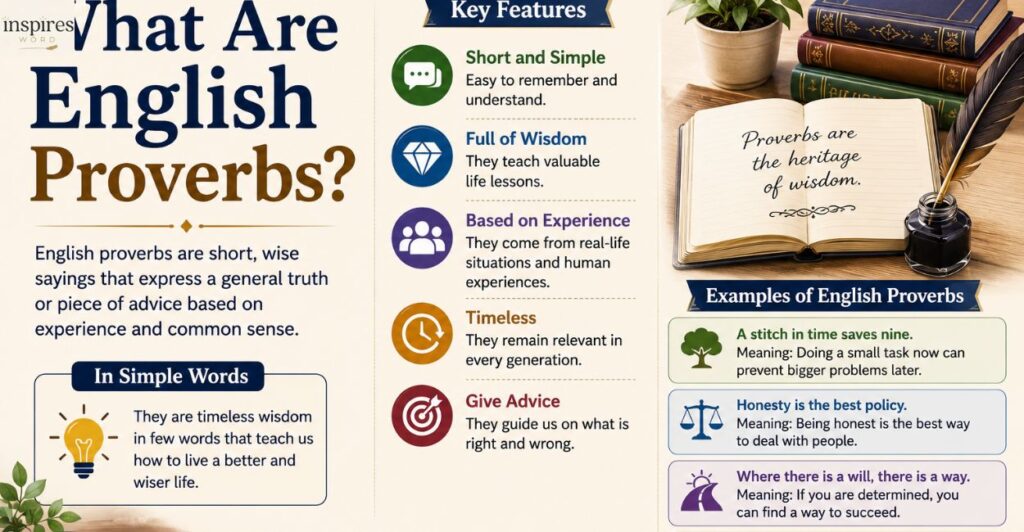
An English proverb is a short, well known sentence that expresses a piece of practical wisdom, advice, or a general truth about life. Proverbs are usually passed down orally through generations,
which is why many of them use simple, memorable language and rhythm, such as haste makes waste or look before you leap.
Because proverbs are meant to be repeated across many different situations, they are intentionally general rather than specific. A proverb rarely names a particular person, place, or event; instead,
it describes a pattern of human behavior broad enough to apply to countless real life circumstances, which is exactly what allows the same short sentence to remain useful for hundreds of years.
Most proverbs share a few common features. They tend to be brief, easy to remember, and metaphorical rather than literal. When someone says don’t put all your eggs in one basket, they are not actually talking about eggs; they are warning against risking everything on a single plan.
Proverbs often originate from everyday observations about farming, nature, family life, and human behavior, which explains why ?
so many reference animals, weather, food, and work. Over centuries, the most useful and relatable of these observations survived and spread, eventually becoming part of the shared vocabulary of the English language.
Many English proverbs also come from a mix of sources, including the Bible, classical literature, medieval folk sayings, and translations from other languages such as Latin and French.
Because English has absorbed influence from so many cultures throughout its history, its collection of proverbs is unusually rich and varied compared to many other languages, blending farming wisdom with literary and religious sayings side by side.
Why English Proverbs Are Still Relevant Today

Proverbs remain useful because human nature has not changed nearly as much as technology and society have. People still procrastinate, take risks, fall in love, and face hardship, which is exactly why a proverb written centuries ago can still feel completely relevant today.
Proverbs also make communication more efficient. Instead of explaining an entire concept in several sentences, a speaker can simply say better late than never and instantly convey the full idea.
This efficiency is one reason proverbs continue to appear in books, speeches, workplace conversations, and even social media captions.
For English language learners, proverbs offer an added benefit: they reveal cultural values and common ways of thinking.
Learning that English speakers often say practice makes perfect, rather than a more literal alternative, helps a learner sound more natural and better understand the culture behind the language.
Proverbs also show up frequently in professional and academic settings, which makes them useful well beyond casual conversation.
Business coaches often quote strike while the iron is hot to encourage quick decision making, while teachers use slow and steady wins the race to encourage patience during long term learning.
Because these expressions appear so often in workplaces, classrooms, and media, understanding them is genuinely useful for anyone hoping to communicate confidently in English.
Characteristics of a Good English Proverb
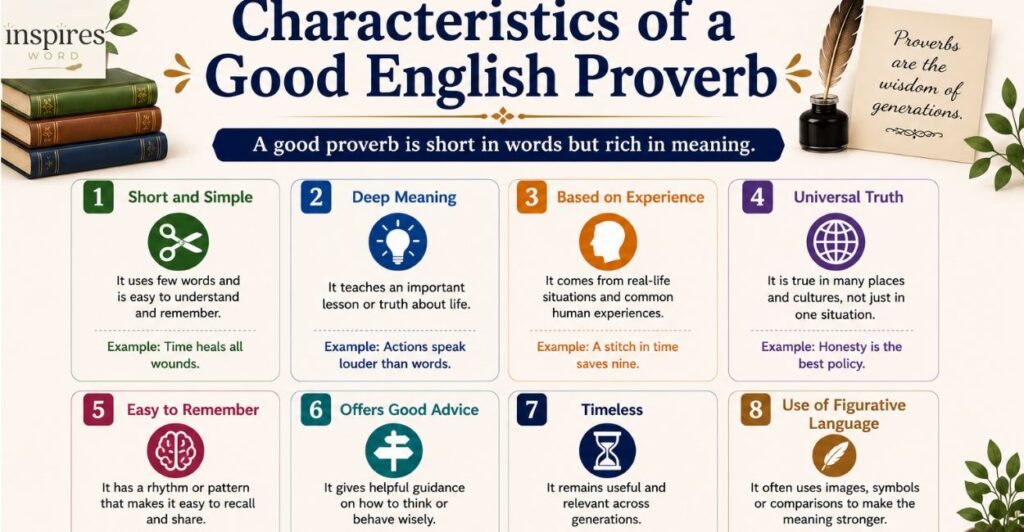
Not every clever sentence qualifies as a true proverb. Proverbs are shaped by generations of repeated use, which naturally filters out anything too complicated, too specific, or too easily forgotten. Most well known English proverbs share the following characteristics.
- Brevity. A good proverb is short enough to remember and repeat easily, usually a single sentence.
- Universal truth. It expresses something widely believed to be true across different situations, not just one specific event.
- Figurative meaning. Many proverbs use imagery or metaphor rather than stating the lesson directly.
- Memorable rhythm. Repetition, rhyme, or a strong rhythm, such as in “no pain, no gain,” makes proverbs easier to recall.
- Long history of use. True proverbs have typically been repeated and passed down for generations, rather than invented recently.
- Practical advice or warning. A proverb usually guides behavior, offering either encouragement or caution.
Difference Between Proverbs, Idioms, and Sayings
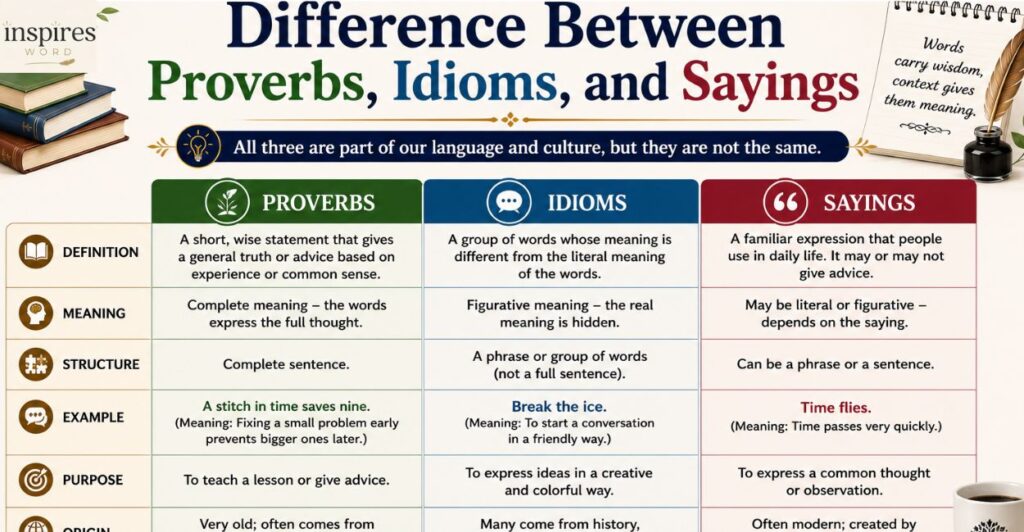
These three terms are often confused, even though they serve slightly different purposes in everyday English.
| Term | Definition | Example |
| Proverb | A short traditional sentence that offers advice or a life lesson | Honesty is the best policy |
| Idiom | A figurative phrase whose meaning cannot be understood from the individual words | Break the ice |
| Saying | A general term for any well known short expression, which can include both proverbs and idioms | Time flies |
The easiest way to tell them apart is to ask whether the phrase teaches a lesson. Proverbs always carry a moral or practical message, while idioms simply describe an action or feeling in a figurative way without necessarily offering advice.
Sayings, meanwhile, act as a broader umbrella term that can include both proverbs and idioms, along with quotes, catchphrases, and other memorable expressions. This is why the word saying is often used loosely in everyday conversation,
while the terms proverb and idiom are more precise and technically defined categories within that larger group.
100+ Common English Proverbs with Meanings
The proverbs below are grouped into five common categories so they are easy to scan, study, or reference. Each one includes a clear meaning along with a simple example sentence showing how it is used in real conversation.
Life Proverbs
- Actions speak louder than words. What someone actually does matters more than what they promise. Example: He said he would help, but actions speak louder than words, so I am waiting to see results.
- Don’t judge a book by its cover. Do not form an opinion about someone or something based only on outward appearance. Example: The restaurant looked plain outside, but don’t judge a book by its cover, because the food was excellent.
- Every cloud has a silver lining. Even a difficult situation usually contains something positive. Example: Losing that job felt awful, but every cloud has a silver lining, since it led her to a better career.
- When it rains, it pours. Problems or events often happen all at once rather than one at a time. Example: First the car broke down, then the roof leaked; when it rains, it pours.
- Time heals all wounds. Painful emotions become easier to bear as time passes. Example: The loss was devastating at first, but time heals all wounds.
- Better late than never. It is better to finish or arrive late than to never do it at all. Example: She finally apologized after two years, but better late than never.
- It’s no use crying over spilled milk. There is no point worrying about a mistake that cannot be undone. Example: The project failed, but it’s no use crying over spilled milk; let’s plan the next step.
- Where there’s a will, there’s a way. Strong determination can help a person overcome almost any obstacle. Example: He had no money for college, but where there’s a will, there’s a way, and he found a scholarship.
- The grass is always greener on the other side. Other people’s situations often look better than they really are. Example: She envied her friend’s job until she realized the grass is always greener on the other side.
- Life is what you make it. A person’s happiness and success largely depend on their own choices and effort. Example: She stopped blaming her circumstances and reminded herself that life is what you make it.
- Don’t burn your bridges. Avoid permanently damaging a relationship or opportunity, since you may need it again in the future. Example: He left the company politely, careful not to burn any bridges.
- Every dog has its day. Everyone eventually gets a chance at success or recognition, even if it takes time. Example: She kept working quietly for years, confident that every dog has its day.
Success and Hard Work Proverbs
- The early bird catches the worm. People who act quickly or start early tend to have an advantage. Example: I always submit applications early because the early bird catches the worm.
- Rome wasn’t built in a day. Important achievements take time and cannot be rushed. Example: Learning a new language is slow, but remember, Rome wasn’t built in a day.
- No pain, no gain. Meaningful progress usually requires effort or discomfort. Example: Training for the marathon is exhausting, but no pain, no gain.
- Practice makes perfect. Repeated effort leads to improvement and skill. Example: Her piano playing improved dramatically because practice makes perfect.
- Don’t put all your eggs in one basket. Avoid risking everything on a single plan or opportunity. Example: He invested in several companies instead of one, since he never puts all his eggs in one basket.
- A journey of a thousand miles begins with a single step. Every large goal starts with a small first action. Example: Starting a business feels overwhelming, but a journey of a thousand miles begins with a single step.
- Strike while the iron is hot. Take action while conditions are favorable, rather than waiting too long. Example: The market was rising fast, so she struck while the iron was hot and sold her shares.
- Slow and steady wins the race. Consistent, careful effort often succeeds better than rushing. Example: He didn’t study everything in one night; slow and steady wins the race.
- Fortune favors the bold. People who take confident action are often rewarded. Example: She took the risky job offer because fortune favors the bold.
- You reap what you sow. The results a person experiences reflect the effort or actions they put in earlier. Example: He studied hard all semester, and in the end, you reap what you sow.
Friendship Proverbs
- A friend in need is a friend indeed. A true friend is someone who helps during difficult times. Example: She stayed by my side through the surgery; a friend in need is a friend indeed.
- Birds of a feather flock together. People with similar interests or values often become friends. Example: All of them love hiking and cooking, so birds of a feather flock together.
- A man is known by the company he keeps. A person’s character can often be judged by the friends they choose. Example: He surrounds himself with hardworking people, and a man is known by the company he keeps.
- Two heads are better than one. Working together often produces better results than working alone. Example: We solved the puzzle much faster once we teamed up, since two heads are better than one.
- Laughter is the best medicine. Humor helps ease stress and improve overall wellbeing. Example: After a rough week, we just watched a comedy together, because laughter is the best medicine.
- United we stand, divided we fall. People are stronger and more successful when they cooperate rather than separate. Example: The team only succeeded once everyone stopped arguing; united we stand, divided we fall.
- Old friends and old wine are best. Long lasting friendships, like aged wine, tend to improve and deepen with time. Example: They have known each other since childhood, proving that old friends and old wine are best.
- A true friend never gets in your way unless you happen to be going downhill. Real friends will speak up honestly, even when it is uncomfortable. Example: She warned me about the risky investment because a true friend never gets in your way unless you happen to be going downhill.
- A friend to all is a friend to none. Someone who tries to please everyone often ends up forming no truly close bonds. Example: He never says no to anyone, but a friend to all is a friend to none.
- Good friends are like stars; you don’t always see them, but you know they are there. Genuine friendship remains strong even during periods of distance or silence.
Love Proverbs
- Absence makes the heart grow fonder. Being apart from someone can increase affection and appreciation for them. Example: They only see each other twice a year, but absence makes the heart grow fonder.
- Love is blind. Strong feelings of love can prevent someone from noticing flaws in a person. Example: Everyone saw the problems in the relationship except her; love is blind.
- All is fair in love and war. People often excuse extreme behavior when it involves romantic pursuit or serious conflict. Example: He surprised her with flowers at work, joking that all is fair in love and war.
- The course of true love never did run smooth. Genuine relationships usually involve challenges along the way. Example: They argued constantly before the wedding, but the course of true love never did run smooth.
- Better to have loved and lost than never to have loved at all. Experiencing love, even if it ends painfully, is more valuable than avoiding it entirely. Example: Despite the heartbreak, she felt it was better to have loved and lost than never to have loved at all.
- Home is where the heart is. A true home is defined by love and belonging, not simply a physical location. Example: They moved often for work, but always said home is where the heart is.
- Distance makes the heart grow colder for some, fonder for others. Long distance relationships affect people differently, and time apart can either weaken or strengthen a bond depending on the couple.
- Marry in haste, repent at leisure. Rushing into marriage without careful thought often leads to regret later.
Wisdom Proverbs
- Honesty is the best policy. Telling the truth is always the most beneficial choice in the long run. Example: He admitted his mistake immediately, believing honesty is the best policy.
- Knowledge is power. Having information and understanding gives a person greater ability and confidence. Example: She researched the contract carefully, knowing knowledge is power.
- A picture is worth a thousand words. An image can communicate an idea more effectively than a lengthy description. Example: The chart explained the data instantly; a picture is worth a thousand words.
- Look before you leap. Think carefully about consequences before taking action. Example: He checked the contract twice, because it is wise to look before you leap.
- Don’t count your chickens before they hatch. Do not assume success before it has actually happened. Example: She celebrated the promotion early, forgetting not to count her chickens before they hatch.
- Better safe than sorry. It is wiser to take precautions than to deal with regret later. Example: We packed extra water for the hike, just to be safe rather than sorry.
- When in Rome, do as the Romans do. Adapt your behavior to match the customs of the place you are in. Example: He removed his shoes at the door, since when in Rome, do as the Romans do.
- A stitch in time saves nine. Fixing a small problem early prevents it from becoming a much bigger one later.
- The pen is mightier than the sword. Words and ideas can have more lasting influence than force or violence.
- All that glitters is not gold. Something that looks valuable or impressive on the surface may not actually be so. Example: The job offer sounded amazing at first, but all that glitters is not gold.
- Wisdom comes with age. Experience and years of living tend to build better judgment and understanding over time.
- Great minds think alike. People who reach the same clever conclusion independently often share similar intelligence or reasoning.
Most Popular English Proverbs Explained
Among the hundreds of English proverbs in everyday use, a small group consistently ranks as the most recognized worldwide.
The table below highlights ten of the most widely used proverbs, along with a short explanation of each.
| Proverb | Meaning |
| Actions speak louder than words | What you do matters more than what you say |
| Don’t judge a book by its cover | Do not judge based on appearance alone |
| Rome wasn’t built in a day | Big achievements take time and patience |
| The early bird catches the worm | Acting early leads to better opportunities |
| Better late than never | Doing something late is better than not at all |
| Honesty is the best policy | Truthfulness is always the wisest choice |
| It’s no use crying over spilled milk | Don’t dwell on mistakes that cannot be fixed |
| Don’t put all your eggs in one basket | Avoid risking everything on one option |
| Where there’s a will, there’s a way | Determination helps overcome obstacles |
| Better safe than sorry | Caution is wiser than regret |
These ten proverbs are especially useful for English learners because they appear constantly in books, workplace conversations, and popular media, making them some of the highest value sayings to memorize first.
English Proverbs Used in Everyday Conversations
Native English speakers use proverbs naturally, often without even realizing it, to summarize advice quickly during conversation.
A manager might say practice makes perfect while coaching a new employee, or a parent might warn a child that don’t count your chickens before they hatch after an overly confident boast.
Proverbs also appear frequently in casual small talk about weather, work, and daily plans. Saying when it rains, it pours after a stressful morning instantly communicates frustration without needing further explanation.
Because proverbs are so deeply embedded in daily speech, understanding them is essential for anyone hoping to sound fluent and natural in English.
Social media has also given older proverbs a new life. Sayings such as when life gives you lemons, make lemonade or better late than never frequently appear as captions, motivational posts, and short video overlays, showing that these centuries old expressions still resonate strongly with modern audiences.
This ongoing popularity proves that a well chosen proverb can feel just as relevant scrolling through a phone as it did being spoken around a dinner table generations ago.
English Proverbs for Students and Learners
Learning proverbs in themed groups, such as by topic or emotion, tends to make memorization far easier than studying them in a random list.
Teachers frequently recommend three simple techniques for mastering proverbs: reading them in context through short stories, practicing them in example sentences, and comparing them to a similar proverb or idiom in the learner’s native language.
This comparison approach helps students connect new vocabulary to concepts they already understand.
Flashcards, short quizzes, and daily proverb challenges are also popular study tools, since repetition over several days is far more effective for long term memory than trying to memorize dozens of proverbs in a single sitting.
Reading proverbs inside short stories or dialogues, rather than as an isolated list, also helps learners understand tone.
A proverb like better safe than sorry sounds cautious and practical, while curiosity killed the cat carries a slightly playful, warning tone, and noticing that difference helps a student use each expression appropriately in real conversation rather than just reciting it from memory.
Old and Ancient English Proverbs
Some of the oldest English proverbs trace back centuries, often originating from early farming communities, religious texts, or classical literature translated into English.
- A watched pot never boils. Time seems to move slower when you are anxiously waiting for something to happen.
- Haste makes waste. Rushing through a task often leads to careless mistakes and wasted effort.
- Many hands make light work. A task becomes easier when several people share the effort.
- The apple doesn’t fall far from the tree. Children often resemble their parents in behavior or character.
- A bird in the hand is worth two in the bush. It is better to keep something you already have than to risk it for something uncertain.
- Out of sight, out of mind. People or things that are not seen regularly are more easily forgotten.
- All good things must come to an end. Even the most pleasant experiences eventually stop.
- Don’t bite the hand that feeds you. Avoid hurting or betraying someone who supports or helps you.
These older sayings have survived for generations because their lessons remain just as practical today as they were
when farming, trade, and oral storytelling shaped daily life. Many of them were first recorded in early English texts, folk tale collections, and translated classical works, then repeated so often in households and communities that they eventually became permanent fixtures of everyday speech.
Funny English Proverbs
Not every proverb is purely serious. Some carry a light, humorous tone while still delivering genuine advice.
- If you can’t beat them, join them. When you cannot win against a group or trend, it is sometimes easier to become part of it instead.
- Curiosity killed the cat. Being overly curious about something can lead to trouble.
- You can’t have your cake and eat it too. You cannot enjoy two conflicting benefits at the same time.
- Don’t cry over spilled milk, unless it’s on your favorite shirt. A playful twist on the classic proverb, reminding people not to take small setbacks too seriously.
- An apple a day keeps the doctor away, but only if you aim well. A humorous spin on the health related proverb about apples and wellness.
- When life gives you lemons, make lemonade. Turn a difficult or disappointing situation into something positive.
Short English Proverbs Easy to Remember
Short proverbs are especially popular because they are quick to say and simple to remember, even for beginner English learners.
- No pain, no gain.
- Easy come, easy go.
- Practice makes perfect.
- Better late than never.
- Time flies.
- Seeing is believing.
- Out of sight, out of mind.
- Love conquers all.
- Knowledge is power.
- All’s well that ends well.
Short proverbs like these work well as vocabulary starters for children and new English speakers, since they can be memorized in seconds and reused across many different conversations.
Proverbs from the Book of Proverbs
The Book of Proverbs, found in the Bible, is one of the oldest known sources of proverbial wisdom and has influenced many sayings still used in English today.
- Pride goes before a fall. Excessive pride or overconfidence often leads to failure or embarrassment.
- A soft answer turns away wrath. Responding calmly to anger often defuses conflict more effectively than arguing back.
- Iron sharpens iron. People help one another grow and improve through honest interaction and challenge.
- The truth will set you free. Honesty ultimately leads to relief and a clearer conscience.
- Spare the rod, spoil the child. This older saying reflects a traditional belief that a lack of discipline leads to poor behavior in children.
These biblical proverbs are frequently referenced in literature, sermons, and everyday speech, even by people who may not realize the exact verse or chapter the phrase originally came from.
English Proverbs Compared to Sayings in Other Languages
Many proverbs share a similar core lesson across different cultures, even though the exact wording and imagery can vary significantly.
| English Proverb | Similar Meaning Elsewhere |
| The early bird catches the worm | Many cultures use a similar phrase encouraging early action and initiative |
| Don’t put all your eggs in one basket | Common in many languages as a warning against risking everything at once |
| Actions speak louder than words | A widely shared idea across cultures that behavior reveals true character |
| Better late than never | Found in various forms encouraging persistence despite delay |
| A bird in the hand is worth two in the bush | Appears in many cultures as advice to value what is certain over what is uncertain |
This overlap shows that while the specific wording of proverbs is unique to English, the underlying life lessons are often part of a much broader, shared human experience.
How to Use English Proverbs Correctly
Using a proverb correctly requires more than memorizing the exact words. Context matters just as much as wording, since a proverb used at the wrong moment can feel confusing or out of place.
A good rule of thumb is to use a proverb only when it directly relates to the situation being discussed.
Saying honesty is the best policy makes sense after a conversation about telling the truth, but it would feel awkward if inserted randomly into an unrelated topic.
It also helps to slightly adjust tone depending on the setting.
Formal writing, such as an essay or business email, generally benefits from well known, widely accepted proverbs, while casual conversation allows more flexibility, including humorous or regional variations.
Overusing proverbs can also weaken their impact.
A single, well placed proverb can strengthen a point powerfully, but stacking several proverbs together in one paragraph often makes writing feel cluttered or overly rehearsed.
As a general guideline, one clear proverb per paragraph or key point tends to read far more naturally than several in a row.
Common Mistakes to Avoid When Using English Proverbs
Even confident English speakers sometimes misuse proverbs. Being aware of these common mistakes can help you sound more natural and accurate.
- Changing key words incorrectly. Swapping words in a fixed proverb, such as saying every cloud has a golden lining instead of silver lining, can confuse native speakers.
- Using a proverb out of context. A proverb should directly connect to the topic being discussed, not be inserted simply because it sounds impressive.
- Mixing up similar proverbs. Phrases such as actions speak louder than words and practice makes perfect have very different meanings, even though both relate to effort and behavior.
- Overexplaining after using a proverb. Part of a proverb’s power comes from its brevity, so immediately restating the same idea in plain language afterward can feel repetitive.
- Assuming every culture has an identical version. While many proverbs share a similar theme across languages, the exact wording and imagery are often unique to English.
Avoiding these mistakes takes practice, but paying close attention to how native speakers naturally use proverbs in books, conversation, and media is one of the fastest ways to build accuracy and confidence.
Tips for Remembering English Proverbs
Learning dozens of new proverbs can feel overwhelming at first, but a few simple strategies make the process much easier.
- Group proverbs by theme, such as love, success, or friendship, rather than memorizing them in random order.
- Create a short example sentence for each proverb to reinforce how it is actually used.
- Compare it to a saying in your native language with a similar meaning, if applicable.
- Practice using proverbs out loud in everyday conversation to build natural confidence.
- Review a small batch regularly instead of trying to memorize a long list all at once.
- Write proverbs on flashcards and quiz yourself a few times each week for stronger retention.
Combining several of these strategies at once, rather than relying on just one, tends to produce the fastest results.
A learner who groups proverbs by theme, writes example sentences, and reviews them weekly is far more likely to retain and correctly use dozens of proverbs within just a few months.
Frequently Asked Questions
What are the top 10 proverbs?
Widely recognized top proverbs include actions speak louder than words, the early bird catches the worm, and honesty is the best policy, among others listed in the table above.
What is the most used proverb?
Actions speak louder than words is often considered one of the most frequently used English proverbs in everyday conversation.
What is the most beautiful proverb?
Many readers consider every cloud has a silver lining among the most beautiful proverbs, since it blends comfort with genuine hope during hard times.
What are some old proverbs?
Classic older proverbs include a watched pot never boils, haste makes waste, and many hands make light work.
What are the wisest proverbs?
Proverbs such as look before you leap, honesty is the best policy, and a stitch in time saves nine are often ranked among the wisest for their practical, timeless guidance.
What is a good proverb to read?
Where there’s a will, there’s a way is a popular, motivating proverb often recommended to readers seeking encouragement.
What are some funny proverbs?
Lighthearted examples include if you can’t beat them, join them and curiosity killed the cat, both of which mix humor with genuine advice.
Final Thoughts
English proverbs offer far more than clever wording; they carry centuries of practical wisdom passed down through generations of everyday life. From lessons about hard work and patience to guidance on love, friendship, and honesty, these short sayings continue to shape how English speakers think, communicate, and offer advice.
Whether the goal is mastering English as a second language, writing a more engaging essay, or simply enjoying timeless wisdom, this guide offers a strong foundation. Proverbs are best learned gradually, a handful at a time, with real examples and regular practice rather than rushed memorization, since genuine fluency comes from actually using these expressions in everyday conversation and writing.
Explore the linked cluster articles on life proverbs, success proverbs, friendship proverbs, love proverbs, and wisdom proverbs for a deeper dive into each category, and consider bookmarking this guide as a quick reference the next time you come across an unfamiliar English saying.
